Anyone who works with advertising learns one habit early: read the claim, then look for the footnote. A banner promises "up to 50% off," and the asterisk tells you what that really means. That habit is useful far outside marketing, and it turns out to be a good way to prepare for a test that is full of precise facts and carefully worded questions.
Picture a media buyer in her early thirties who has moved to the UK for a job at a small agency. She spends her days checking whether ad copy matches the landing page, and she is good at it. Now she also has a Life in the UK test to pass as part of her settlement plans, and she is treating it like a campaign audit. This article follows that approach step by step, using what the Be Ready Education practice page actually offers, including the parts that are still unfinished.
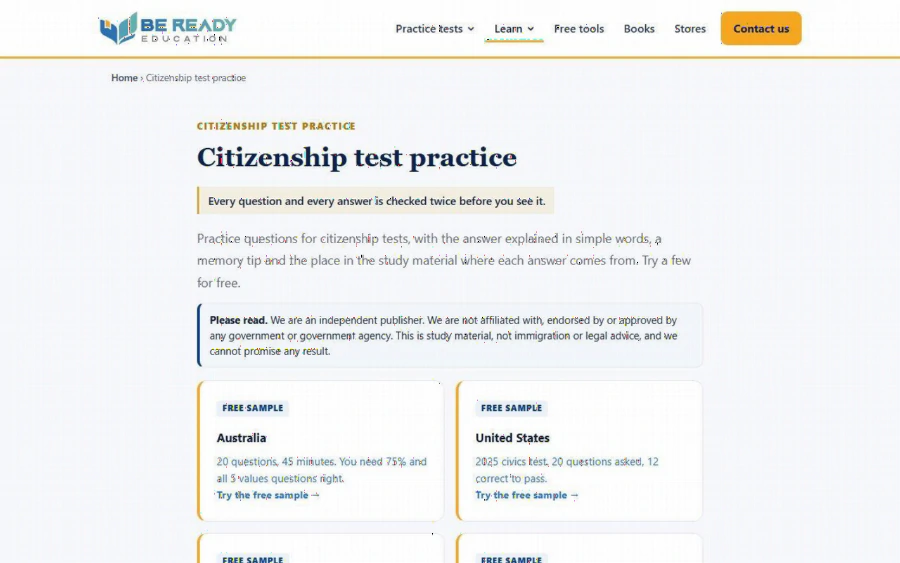
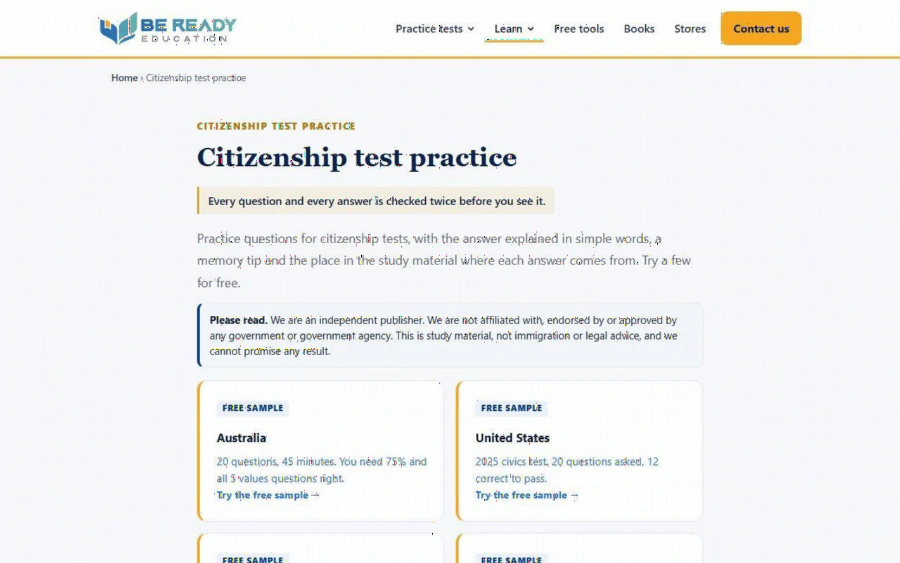
The Be Ready Education citizenship test practice page, with a note that every question and answer is checked twice and free sample cards for each country.
Start with the facts of the test, not the rumours
Before practising anything, our media buyer writes down what the test is. According to the Be Ready Education page, which cites GOV.UK and says it was read on 3 November 2026, the real test has 24 multiple-choice questions, lasts 45 minutes, and is taken at a test centre. The pass mark is 75% or more, which the page spells out as 18 of 24. The page also notes that the format was checked on 2 November 2026 and that rules and fees can change.
That last sentence matters. A good auditor does not treat any single page as final, so she keeps the official source open in another tab and uses practice material only to train recall. The practice page says the same thing about itself: it describes the material as independent, not affiliated with or approved by the UK Government, the Home Office or TSO, and not immigration or legal advice. Reading that disclaimer is part of the audit, and it is a point in the page's favour that it is stated plainly rather than buried.
Try the free sample before you commit to anything
The first step costs nothing. The page offers five free questions with no sign-up. After each answer you see why it is right, an explanation in simple words, and a memory tip. A media buyer would call this a pilot: small, cheap, and enough to judge quality.
Here is what she looks for in those five questions. Is the wording clear? Does the explanation teach something or only repeat the answer? Does the memory tip actually stick? She also tries the controls above the questions, which let her change the text size, switch on high contrast, and choose whether answers are explained in standard or simple English. For someone reading a second language at the end of a long workday, that switch is not a gimmick. It is the difference between finishing a session and giving up halfway.
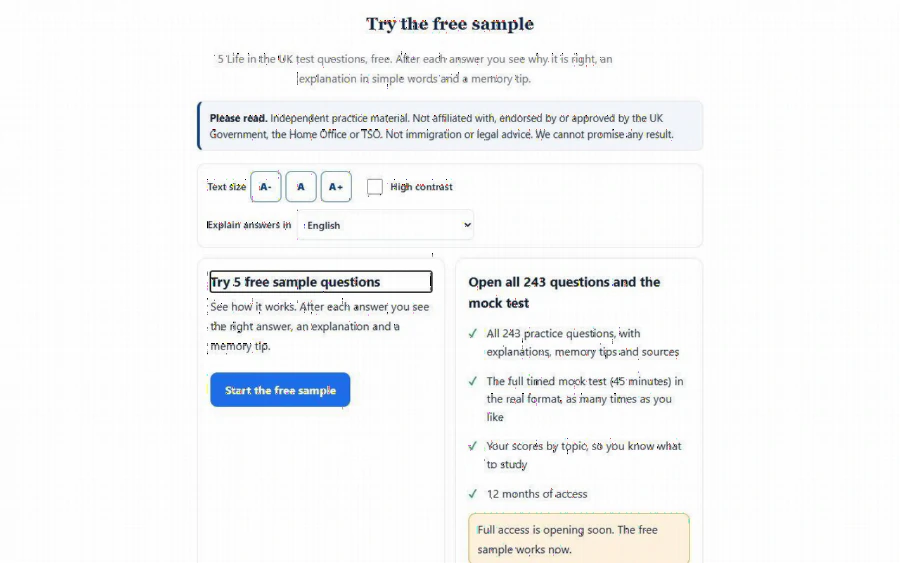
The free sample screen showing five Life in the UK test questions, accessibility controls, and a list of what full access will include.
What the full question bank is meant to do
The page states that there are 243 practice questions, compared with 24 in the real test. That ratio is the point. A bank roughly ten times the size of the exam lets you see each topic from several angles, so you learn the idea instead of memorising one phrasing. For a person who audits copy for a living, this is familiar: you do not trust a claim that survives only one wording.
According to the page, full access adds four things on top of the sample:
- every practice question, worked through one at a time with the correct answer shown after each response;
- timed mock tests in the real format, with the same number of questions and the same pass mark as the real test, and all answers shown at the end;
- an explanation in simple English and a memory tip for each answer, with a link to the related part of the study material;
- scores by topic, kept in your own browser, so you can see what to study next.
The page also says the questions are the company's own wording, written from facts in the study handbook, and that each answer points to its related chapter. It states that the site does not copy the official text or use government logos. For a careful reader, "a source for every answer" is the most useful line on the page, because it turns a wrong answer into a reading assignment rather than a mystery.
A realistic weekly plan
Our media buyer has a fixed constraint: about four evenings a week, forty minutes each. She does not need a heroic schedule. She needs a repeatable one. Below is a plan built on the page's own features, with the numbers being her assumptions rather than anything the site promises.
1. Week one: take the free sample, then read the relevant chapters of the official handbook with the sample questions beside her.
2. Weeks two and three: work through the bank in topic blocks, and after each block read the source link for every question she missed.
3. Week four: use the topic scores to find the two weakest areas and spend most evenings there.
4. Final days: take timed mock tests, and treat the 18 of 24 pass mark as the line she wants to clear with room to spare.
The timed mock test is the part she values most. Knowing the material at a kitchen table is different from reading 24 questions against a 45-minute clock in an unfamiliar room. The page says the mock test uses the same number of questions and the same pass mark as the real test and can be repeated as often as you like, which is exactly what you want from a rehearsal.
The key words videos
Life in the UK questions often hinge on a single unfamiliar word. The page links to 31 key words taught in short videos. According to the page, each video gives a simple meaning, an example, a memory tip and three quick questions, and the videos are free, in English, and captioned. There is also a read-only list of all 31 words for people who prefer to skim.
For our media buyer, this is the equivalent of a glossary pass before an audit. She watches a few words each evening, and the three quick questions stop her from nodding along without learning anything.
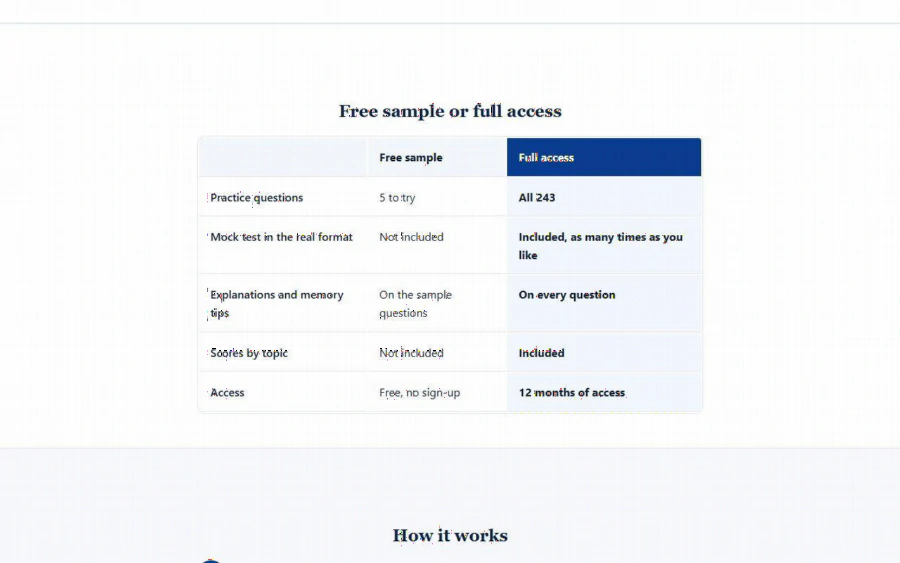
The comparison table on the page showing the free sample versus full access: 5 questions to try versus all 243, mock test included only in full access, and 12 months of access.
Limits you should know about
A fair review has to include the footnotes, so here they are.
Full access is not on sale yet. At the time this page was read, it said full access is "opening soon" and the free sample works now. The page shows no price, so this article gives none. If you are reading this later, check the page for the current status before planning around the paid features.
It is practice material, not the real exam. The page is explicit that it is not the real Life in the UK test and promises no result. Nothing here replaces reading the official handbook, and nothing here should be treated as legal or immigration advice.
It does not handle your application. The FAQ says the site does not assess eligibility or help with applications. It is a study tool only.
Scores stay in your browser. Topic scores are tracked in your own browser, which is good for privacy, though it also means progress is tied to that device and browser. If you switch phones halfway through, check how the page handles it.
Who it suits, and who it does not
This kind of practice suits people who already have the handbook and want structured repetition: shift workers, parents, and anyone preparing in a second language who benefits from simple-English explanations. It is also useful if you like to see your weak topics in numbers rather than guess.
It suits you less if you want a guarantee, if you need help with the application itself, or if you prefer to study only from printed material. In those cases the official handbook plus a notebook may serve you better.
How to begin today
The cheapest next step is also the most informative one. Open the life in the UK test practice page, take the five free questions, and judge the explanations the way you would judge any piece of copy: is it clear, is it sourced, and does it make you smarter about the topic afterwards? If you also plan to look at other countries' tests, the free samples for the other countries lists them side by side.
Then do what our media buyer does with every campaign: write down the facts of the test, set a calendar of short sessions, check your scores by topic, and keep the official GOV.UK information as the final word. Careful readers tend to do well on careful tests.


